
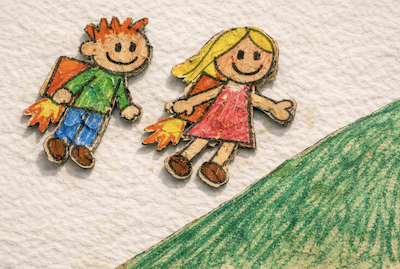
I. 2003: Making Kids Fly
In 2003, my media company was hired by a New York arts foundation to “explore filmmaking with children.”
We’d been working with MTV, Disney, HBO Family mocking up projects FOR kids. But suddenly, we had been tasked with finding ways ten-year-olds could make "content" FROM kids. We were way ahead of our time. Before Youtube, Tiktok, Twitter, IG, smartphones & apps.
All the media tools and tech that used to cost as much as a house was migrating into our pockets. Anybody who was paying attention at the time saw it coming like a freight train.
We landed on stop-motion animation: simple, tactile, instantly gratifying. Crayons, paper, scissors, a still camera that looked like NASA surplus. No iPads, no software, just patience and imagination.
We experimented with Legos, clay, toys, and cut paper. Cut paper won. Legos were insanely difficult for small hands. Clay was a mess and difficult to manipulate and rig. Toys were other people's IP and they limited our storytelling range.
So we went with cut paper movies in stop motion. The kids had to cut out their own drawings and bring them to life in a story with a beginning, middle and an end.
Six weeks later, the kids had made three films, while we directed them through the basics of timing and spacing for stop motion. Rough animation, but still - a movie!
Yes, was our answer to our client. Kids making movies could be done. Reimagining stop motion was the ideal way to teach film making in the classroom.
The board's favorite of the three was Jack and Jill.
Jack and Jill rocketed up the hill to fetch the pale of water - with jetpacks on. Both crashed in spectacular slapstick fashion. Jack’s jetpack was nicknamed Crown (which he crashed), and Jill twirled through the sky before crashing beside him, cartoon birds circling overhead.
When it screened for the funders and patrons, the room howled. They loved it. The young film makers were invited and they took a bow to a standing ovation. The client had an in to the 21st Century Literacy Summit at George Lucas’s Skywalker Ranch, sponsored by the Edutopia foundation - a gathering of the great minds of media education coming together to formulate a media skills vision for kids in the age of digital video proliferation.
And so began our brush with EdTech visual literacy fun.
Or farce.
II. The Experts Who Blinked
Soon our Jack and Jill movie was screened for an audience of academics and policymakers at Edutopia's 21st Century Literacy conference. A gathering of the self-declared pioneers of the “new literacy” that was being enabled by the democratization of tech migrating into our pockets.
When the lights came up, polite applause. Then during a Q/A: “That couldn’t have been made by children. Who did this really?" Apparently, ten-year-olds couldn’t possibly understand camera angles, rhythm, editing or timing. Word reached us later that the film had been dismissed as “clearly adult-produced” and quietly scrubbed from the conference PDF report. Nice try was the verdict.
That’s when I knew we’d struck gold. Because if the people defining 21st-century literacy couldn’t recognize the solution when "it" danced in front of them- the "it" being actual visually literate kids rocking these digital tools, then they weren’t pioneers - they were tourists with clipboards.
This was years before YouTube, before smartphones, before stop-motion apps. Our kids had done it the hard way — frame by frame, click by click - with a soon-to-be-obsolete camera, and expert adults literally couldn’t see it.
That moment was the birth of Animating Kids. We knew there could be a future in developing a systematic way to teach every aspect of film making, only using age appropriate Disney-esque animation classic rules and stop motion to slow it down to one frame at a time.
It wouldn't happen for another decade, but we knew what we had to do eventually, on the side, while the tectonic plate shift of tech and media platforms developed over the next few years.
III. The Dream and the Grease Factory
In 2003, we believed media tools would soon be as common as pencils. When that happened, every child would need to learn to write and read with them — to produce, interpret, and resist the persuasion of screens.
Get kids behind the magic and show then how all the knobs and dials worked, revealing every trick the Hollywood tool box used for 100 years.
The conferences were electric. “Creativity, Collaboration, Critical Thinking!” The slogans were perfect — and perfectly harmless.
That was the dream.
Then came the think tanks and their "white papers".
Soon the dream ossified into institutional frameworks, rubrics, and funding charts.
The Grease Factory was born — a bureaucratic marvel that hums like a Wonka machine, producing white papers about producing more white papers. You can almost hear it's cogs wheezing:
“Reframing Participatory Praxis Through the Semiotics of Transmodal Youth Agency.”
“A Longitudinal Inquiry into Algorithmic Resilience and Posthuman Pedagogical Affordances.”
“Toward a Holistic Framework for the Reflexive Inculcation of Creative Literacies in Hybrid Ecologies.”
“Interrogating Narrative Ontologies: The Matrix of Affective Content Creation Across Emergent Modalities.”
“Reconceptualizing the Epistemic Elasticity of Youth-Centered Semiotic Assemblages in Post-Digital Learning Spaces.”
“Reimagining Engagement Through Reflexive Modalities of Praxis” just before lunch.
You know - grease!
IV. The Ideological Hijack
Then almost every “media ed” conference session started hijacking mediaEd for themes. We kept hearing: “You can inject visual literacy into your curriculum if the kids make movies about climate change, equity, or indigenous awareness.”
Translation: We’ll permit media production with kids as long as it is on a worthy topic. No imagination for imagination’s sake.
That’s not literacy; that’s propaganda rehearsal. It’s like “You can only use this pencil to write thing that fit our message.”
Meanwhile, our students proved that kids thrive when they drive. When their wild ideas fuel their projects, they light up. When adults hand them “approved issues” and matrices, they go limp. Hence our storytelling in Animating Kid’s process stays silly and improvisational to this day.
Animating Kids animates kids by freeing them to imagine. Assigning kids subjects anesthetizes them.
But we get ahead of ourselves. Back to 2005. We were funded to do about two school years worth of testing and piloting. Get some milage under this visual literacy vehicle. When it came time to launch our pilot into the real world, our client chickened out on actually teaching animation to kids.
They opted for a "animator in residence" program instead, where an official "working animator" would oversee the process. I reluctantly wrote and designed that program. It was a demoralizing exercise. I knew kids could develop actual skills. But no, despite our protestations that kids could actually learn animation via stop motion, the training wheels stayed on while the adult in the room with "expertise" ran things.
We recruited professional animators who had a love for education. It worked fine, but they really were doing a lot of the animation. Ironically proving the point made by the 21 Century Skills conference years earlier. "Done by an adult!"
I was a "resident" here and there during the early years of the program. When I had a chance to take a class, I had the kids run everything. I was the hearder in residence. And I took notes. I developed a list of all the skills I'd have taught had I empowered these kids with the actual theory and first. principles of animation and storytelling.
The kids made movies with alacrity. To funders, this whole exercise was "hight tech". To the kids, tech was infrastructure. Non threatening. In their wheel house. I just had to nudge here and there.
My own kids were guinea pigs as we developed and tested whether this film making thing could even be a thing way back 2003. I tested everything on them before we piloted ideas with classroom kids.
I told them I'd like to go forward and do skills based series about kids learning the stop motion skills. This would not be in schools, but rather online. A stop motion Youtube channel with my kids producing their own lessons to teach the secrets of animated story telling - a by kids, for kids thing.
They'd spent their wad on the "animator in residence" program and were happy to let me go off and do my vision. I had no non-compete. After they gave their blessing we started building a studio in our basement.
Within two years, my boys were walking the red carpet at the Tribeca Film Festival, having produced an animation that caught the eye of the founders of Tribeca Film Festival. We soon had 60K twitter followers, and we were inundated with requests for how we did it with such young kids.
V. From Jetpacks to Chefs
From 2007 to 2014, our family ran a YouTube channel that was a cooking show format like Iron Chefs. A giant pot of random items poured out onto kitchen table each episode. My boys dressed like chefs had to cook up an animation that brought the items to life with an animated story. Kids teaching kids how to tell stories through animation. They were (are) the Animation Chefs.
Animation Chefs soon spread to 20 countries, took us to Rwanda and Qatar, New York and SXSW and was a real hit.
We also started an after school film school in our community, and finally the Animation Chefs were making money doing stop motion. Youtube never paid anything at that time.
By 2015, we stopped the Youtube channel, did a crowd source funding campaign, and created Animating Kids. We plowed a lot of time, sweat, tedious lesson creation and love into amassing all our experience from years of creating content for fun. 4 years later? Animating Kids
Twenty thousand students later, that we know of, can spot an L-cut from a J-cut, a close-up from a slow burn. They understand that camera angle equals attitude, that rhythm carries meaning, that stories move people because people emote.
Our acolytes are quite literally, 21st-century literate.
VI. What the Experts Still Don’t Get
They make frameworks. We make films.
They predict the future. Our kids already edit it. We are 1/4 of the way into the 21st Century, and we still don't have any standards or interest in teaching kids the magic of movie or video persusation. At least in the US. Canada and Western Europe are light years ahead of the US.
So we carry on - quietly, stubbornly, joyfully.
Every cutout, every click, every burst of laughter is an act of rebellion against the Grease Factory.
Our metrics are laughter per minute and curiosity per frame of content.
Our ROI is wonder.
VIII. The Final Frame
Two and a half decades after the George Lucas kick-off, media education flew up the hill in jetpacks, lost control, and crashed spectacularly - a brilliant launch, comic midair confusion, hard landing.
We've had a front row seat.
We’ll keep teaching kids to fly their own jetpacks — to use sound, motion, and story to make sense of their world — while the Grease Factory keeps producing grease about grease production.
Because somebody has to make meaning while the rest make meetings. Industry is happy to raised a generation fluent in posting but illiterate in persuasion.
And in the end, the only real literacy worth fighting for is the one that moves the kids. Stories in motion equals emotion.
Thank you for coming along for the ride.
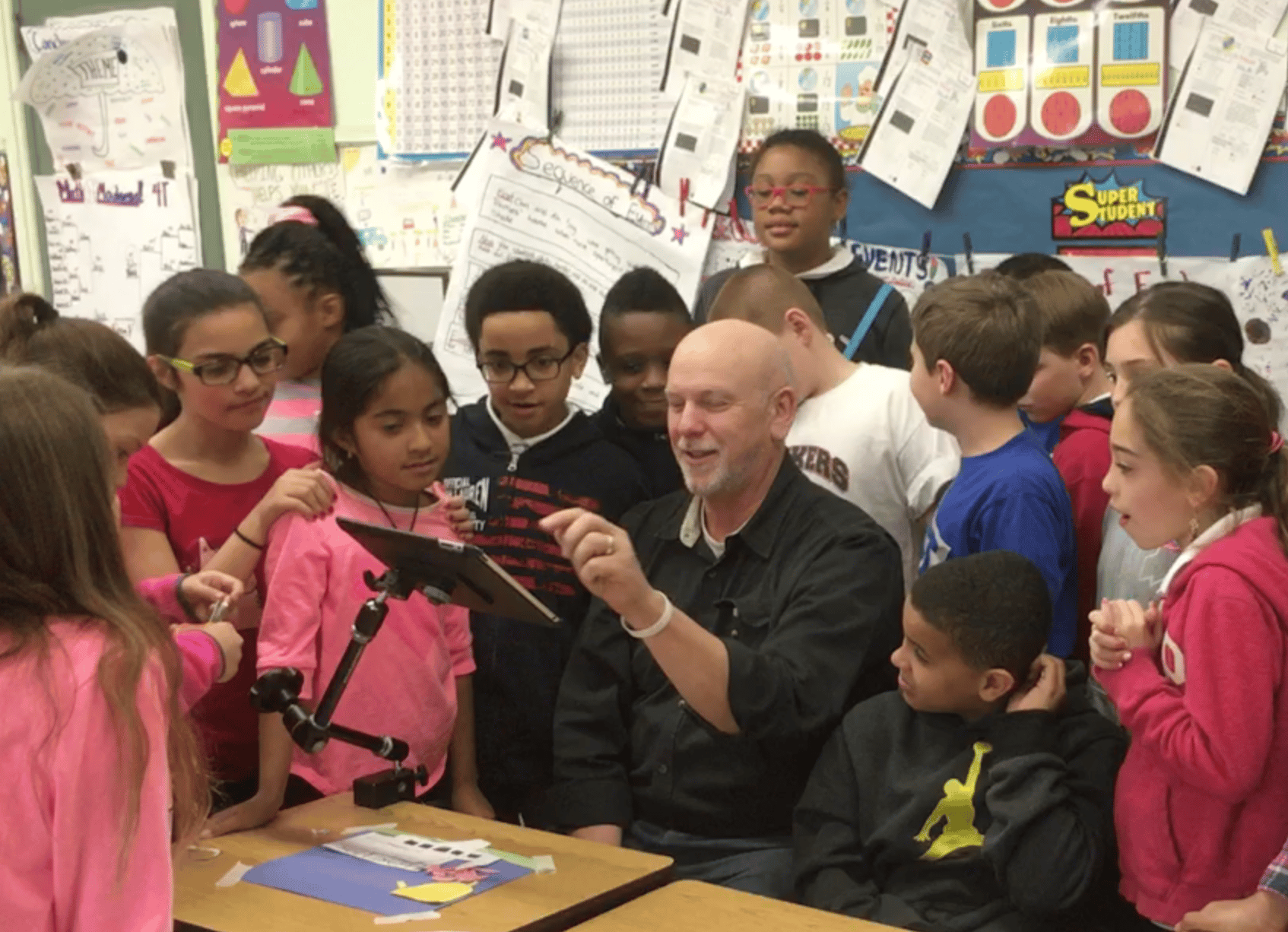
Joe Animates With Kids. The Kids Are Animated1 Animating Kids indeed.
Joe Summerhays is the creative force behind Animating Kids and Animation Chefs, the globally adopted anti-slop media literacy platforms that turn learning spaces into movie studios and students into visual storytellers.
AI can generate infinite content. Joe teaches kids to generate meaning. They learn how sound and motion persuade, shape emotion, and steer perception, then use those tools to author stories on purpose.
Over the past two decades, Joe has trained 25,000+ kids and educators across 20+ countries, giving schools a practical, repeatable system for real media agency.
An award-winning creative executive across software, TV, publishing, and advertising, Joe brings industry-grade persuasion into primary education and flips it into kid defense. His Animation Chefs Colored Hat Levels, inspired by karate belts, guides media coaches from storytelling basics to full film production.
Using handmade cut-paper stop motion, Animating Kids keeps it human. It slows media down frame by frame so students can see how it works, then rebuild it into stories they own. The result: kids who spot manipulation, resist AI slop, and communicate with clarity.
More Testimonials:
"I am impressed by...these programs, providing young people with the skills to become creative and critical thinkers...this shares my dedication to nurturing the next generation of filmmakers and visual storytellers."— Steven Spielberg - Referencing the work of Joe Summerhays“
"Joe (Animating Kids Founder) has turned the art of movie making for kids into a science.” — Jonathan Demme - Academy Award-Winning Director
“I absolutely love Animating Kids...you have no idea how amazing it is for a span of K-9. I’ve got the whole building covered and my planning was done for me. The kids LOVE the Animation Chefs. Win, win!!”— J. Tuttle - Media Specialist
"When I found Animating Kids it changed everything. Small and not so small humans became masters of sound and motion on any subject via small group PBL dynamics."— Rachel - Tech Coach - Quebec
“Animating Kids has changed everything! Fun, relevant media-making lessons for kids, and total P.D. for my non-film making teachers. A complete solution!!” — Principal - Bronx NY
"Animating Kids really helps focus our students during remote sessions…it keeps them so engaged. Your secret recipes are a life saver." — Marisol - Sacramento Ca
"The kids love the demonstrations and it is P.D. for me as I tee it all up. Animating Kids makes me the coolest educator in their lives!" — Charlotte - London UK
"This is the most important skills-based content for today’s kids. I don't think primary educators get how impactful this approach can be. It respects media content creation as the basic literacy it is for today’s kids. — Monique - White Plains NY
“We went through the entire process (PD workshop) of learning animated filmmaking with our tablets and smartphones. We could barely keep up. In the end we came away exhilarated rather than exhausted.” — Cathy S. - Librarian“
"My head was spinning. It involved: math, writing, science, team building, art, language arts, engineering, improvisation, innovation, acting, etc. Along with another dozen areas I can’t recall. Sneaky comprehensive. Mind blown. Can’t wait to use it in class.” — Marcia - 4th Grade Teacher
“Animation Chefs have created a really inspired program! My test group of (hardened gang members) like to laugh at the videos, and they love the simple clear explanations. They just have a blast...”
— G. Zucker Austin TX
"Thank you SO much for sharing your wealth of information and opening this world to every kid! I first learned about you when my husband introduced our daughter to you. Now I am bringing it into my after school program. I’m so psyched!" — Joy H. Retail After School Specialist
"Kids sign-up for robotics, coding, and stop motion sessions. After taking all three, they rate stop motion as their favorite track BY FAR. Animating Kids is key to our success." — Shane V. After School District Lead