
AI Generated Slop
“Seeing Is Believing”?
Those days are over.
Reverse the clock 20 years. In the early YouTube era, “Broadcast Yourself” was the promise. Mass distribution went permanent. But it still required humans, time, production, archives, effort, and friction.
It seems quaint now.
Youtube's original motto “Broadcast yourself” has mutated into “AI will broadcast anything.” Authenticity can be imitated at industrial scale, and the cost of persuasion has collapsed.
So what’s the antidote? Short of unplugging every screen and moving to a cabin with a typewriter?
WHY THIS BOOK, WHY NOW
Twenty years ago Animating Kids and other media skills programs would have been powerful enrichment. In 2026, it’s basic defense.
The media environment is increasingly chemically contaminated.
We need practical inoculation for any educator or parent who can feel AI slop’s undertow.
Recently, Merriam-Webster crowned “Slop” its 2025 Word of the Year, defining it as low-quality digital content produced in bulk by AI. Translation: we finally built a machine that manufactures nonsense faster than humans can scroll past it. Progress.
REALITY CAN BE PRINTED ON DEMAND
Real-looking media can now be produced faster than your brain can evaluate it. The old human defenses, intuition, “vibes,” the comforting belief that “I can tell,” are getting smoked.
Research keeps landing on the same awkward conclusion: in the hardest cases, people are barely better than chance at reliably spotting AI-generated images.
And once media becomes unlimited, the scarce resource isn’t information. It’s your nervous system:
Attention. Emotion. Identity. Belonging. Outrage. Fear. Desire.
The business model is persuasion at scale, tailored, optimized, and relentless. Media with a plan for your nervous system.
Even Adam Mosseri (head of Instagram) said the quiet part out loud: “you can’t trust your eyes the way you used to.” Which is a thrilling statement from a man whose job is basically Head of Looking at Things.
It helps to remember what a screen actually is.
There is no motion on a screen. There are still images, 24 (or 30, or 60, or 120) per second, flashed fast enough to shove your mind into automatic decoding mode.
Ever since stories started glowing from screens in the late 1800s, human nervous systems have been hijacked by illusion, for good and for ill.
Your brain invents movement without asking permission. You don’t just watch the screen. You enter the matrix.
What’s new is the speed, the scale, and the fact that the illusion can now be generated without a human hand anywhere near the craft, and still look human-made.
Whoever controls and edits what you see, when you see it, and how it’s framed plays the banjo with your head. When the “producer” is AI, your internal story can become the fruit of the algorithm's tune.
Scary?
Yes.
Also: predictable. So we can inoculate.
HOW OUR INOCULATION WORKS
Animating Kids doesn’t merely warn students about persuasion. It trains them to build persuasion, slowly, deliberately, frame by frame, on a human level until they can see the levers, knobs, and dials behind screen-based messaging.
That’s why we teach through stop-motion storytelling. Stop motion is wonderfully inconvenient in exactly the right way. It forces persuasion into daylight at human speed. It makes the “trick” visible.
And we do it in a PBL team-based context.
As we build a story from scratch and bring it to life, we pause constantly to point out the miracle and the danger of the mind’s astonishing ability to create meaning from illusion, automatically, instantly, and often unquestioningly.
And we encourage a form of testing entirely unique to regular academic studies. The moment that rewires everything: the screening.
When a student watches strangers laugh, cry, gasp, or scream exactly where the student planned, something snaps into focus. The child realizes, in their bones:
“They felt emotion” doesn’t mean “it’s true.”
It means “it worked.”
That insight, earned not preached, makes them harder to manipulate for the rest of their lives. Not cynical. Fluent.
We've taken them behind the scenes at the magic show. We reveal the angles, the sleights, the patter, while pointing out that today’s algorithm is doing the same magical illusion thing, only at light speed.
So we’re attempting to house all of our discoveries and insights and inoculation into this book: the secret recipes, the principles, the classroom moves, the proofs, and the links out to video demonstrations and student films so you can see it working in the wild.
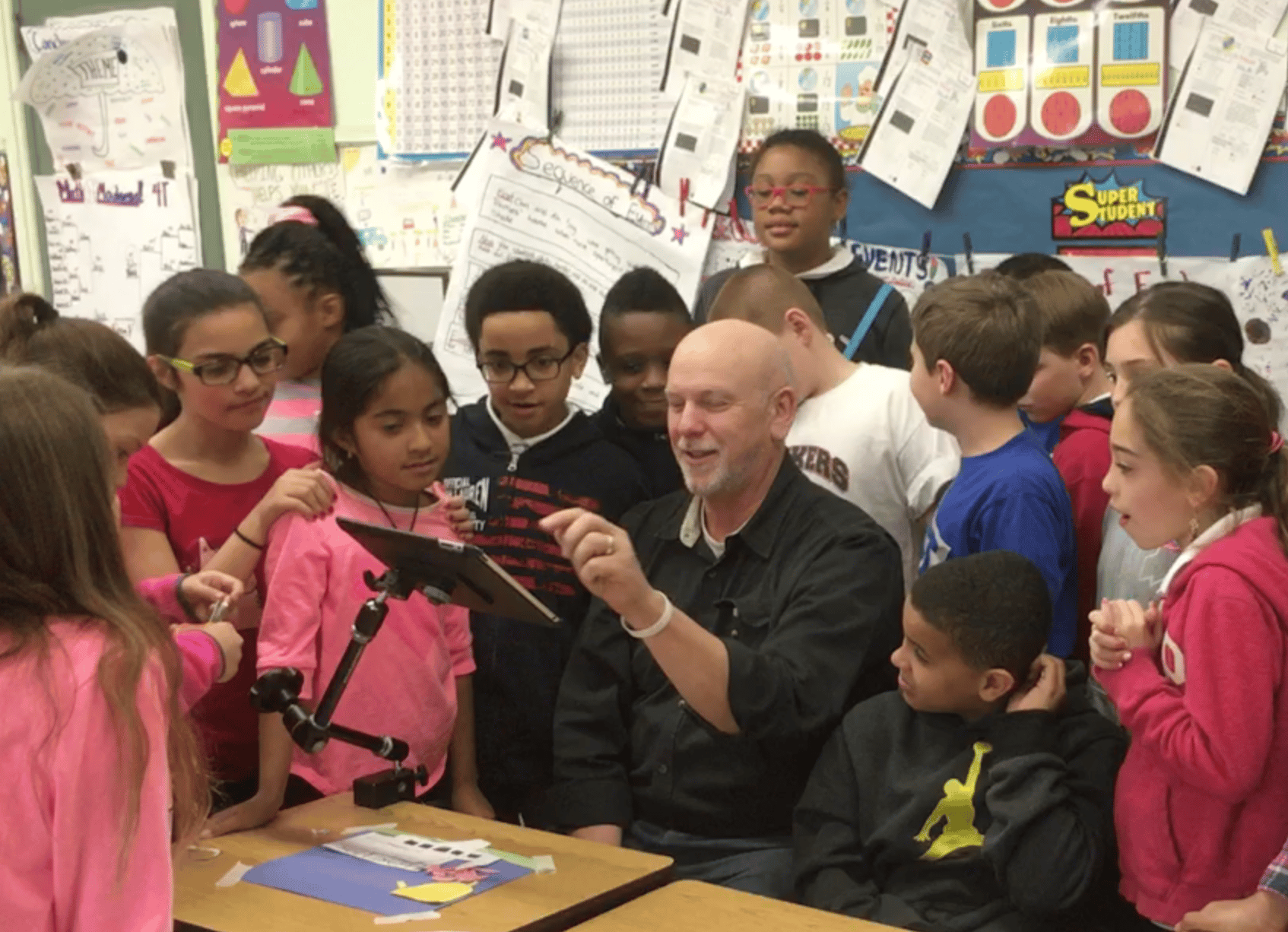
Joe Summerhays is the creative force behind Animating Kids and Animation Chefs, the globally adopted anti-slop media literacy platforms that turn learning spaces into movie studios and students into visual storytellers.
AI can generate infinite content. Joe teaches kids to generate meaning. They learn how sound and motion persuade, shape emotion, and steer perception, then use those tools to author stories on purpose.
Over the past two decades, Joe has trained 25,000+ kids and educators across 20+ countries, giving schools a practical, repeatable system for real media agency.
An award-winning creative executive across software, TV, publishing, and advertising, Joe brings industry-grade persuasion into primary education and flips it into kid defense. His Animation Chefs Colored Hat Levels, inspired by karate belts, guides media coaches from storytelling basics to full film production.
Using handmade cut-paper stop motion, Animating Kids keeps it human. It slows media down frame by frame so students can see how it works, then rebuild it into stories they own. The result: kids who spot manipulation, resist AI slop, and communicate with clarity.
More Testimonials:
"I am impressed by...these programs, providing young people with the skills to become creative and critical thinkers...this shares my dedication to nurturing the next generation of filmmakers and visual storytellers."— Steven Spielberg - Referencing the work of Joe Summerhays“
"Joe (Animating Kids Founder) has turned the art of movie making for kids into a science.” — Jonathan Demme - Academy Award-Winning Director
“I absolutely love Animating Kids...you have no idea how amazing it is for a span of K-9. I’ve got the whole building covered and my planning was done for me. The kids LOVE the Animation Chefs. Win, win!!”— J. Tuttle - Media Specialist
"When I found Animating Kids it changed everything. Small and not so small humans became masters of sound and motion on any subject via small group PBL dynamics."— Rachel - Tech Coach - Quebec
“Animating Kids has changed everything! Fun, relevant media-making lessons for kids, and total P.D. for my non-film making teachers. A complete solution!!” — Principal - Bronx NY
"Animating Kids really helps focus our students during remote sessions…it keeps them so engaged. Your secret recipes are a life saver." — Marisol - Sacramento Ca
"The kids love the demonstrations and it is P.D. for me as I tee it all up. Animating Kids makes me the coolest educator in their lives!" — Charlotte - London UK
"This is the most important skills-based content for today’s kids. I don't think primary educators get how impactful this approach can be. It respects media content creation as the basic literacy it is for today’s kids. — Monique - White Plains NY
“We went through the entire process (PD workshop) of learning animated filmmaking with our tablets and smartphones. We could barely keep up. In the end we came away exhilarated rather than exhausted.” — Cathy S. - Librarian“
"My head was spinning. It involved: math, writing, science, team building, art, language arts, engineering, improvisation, innovation, acting, etc. Along with another dozen areas I can’t recall. Sneaky comprehensive. Mind blown. Can’t wait to use it in class.” — Marcia - 4th Grade Teacher
“Animation Chefs have created a really inspired program! My test group of (hardened gang members) like to laugh at the videos, and they love the simple clear explanations. They just have a blast...”
— G. Zucker Austin TX
"Thank you SO much for sharing your wealth of information and opening this world to every kid! I first learned about you when my husband introduced our daughter to you. Now I am bringing it into my after school program. I’m so psyched!" — Joy H. Retail After School Specialist
"Kids sign-up for robotics, coding, and stop motion sessions. After taking all three, they rate stop motion as their favorite track BY FAR. Animating Kids is key to our success." — Shane V. After School District Lead