
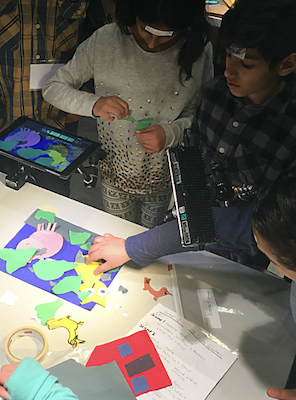
Joe moves from table to table, sleeves pushed up, helping tape down skies and straighten little cardboard doorways. Masking tape loops stuck to everything. Bins bulge with zip‑bags of cutouts—storm clouds, car wheels, rocket switches, and bowling pins.
All the teams are in the home stretch. Beautiful chaos. Joe picks up on unease within the mutters in each group: “Looks dumb.” “It’s so… jittery.” “My drawing looks too small.” “Too many shadows.” "The trees look different in every scene."
Joe smiles. Every time. Every project. No matter the age. No matter the deliverable. The nerves are kicking in. The teams are losing confidence that they are creating something worth watching.
Time for some reality therapy. Joe walks—unhurried—toward the whiteboard.
“Eyes up for a second.”
He writes:
• Idea
• Excitement
• Start
• Grind
• Complications
• Loss of confidence
• PANIC
• No Time to finish
• Trim the Dream
• Ship What’s Left
“Okay, we’ve got two, maybe three sessions left. Here’s the arc of every project I’ve ever seen. We start excited and jump in. Then the messy stuff shows up, but we keep up the work, we grind. Next, complications. The movie in our heads doesn’t match what’s on the table, and we kind of hate it for a minute. Then we lose our momentum, and the whole thing seems like a chore.
Then the deadline looms and BOOM, panic.
So we budget the time we have left, cut what we can’t finish, and deliver the best version we can, even if it’s not the original masterpiece in our brains.
Welcome to every project ever. Sometimes it stings, sometimes it doesn’t, but the steps seem to always be the same.”
Joe lets it all sink in.
“We are never gonna finish this if we only have two more classes!” pouts one young voice.
Silence.
“There’s good news and bad news, which one do you want first?" Joe asks. “The bad news!” most of the class chimes in.
“OK, here’s the bad news. We may have to cut some scenes out of your movie. Or we may have to blend two scenes into one scene. I’ll come around later and let’s look at what you’ve got and we'll make some tough decisions.“ “What’s the good news?“ says a young film maker with a baggie full of props in her hands.
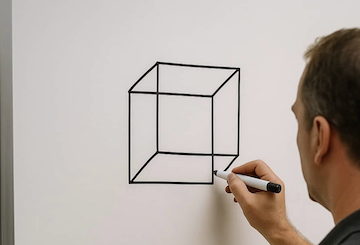
Joe turns to the white board and draws a classic Necker Cube.
Stares.
“Look at this wire frame box and tell me which is the front square of the box and which is the back?“ Joe says.
One hand shoots up. “I see it! It's the one on the... Oh wait it flipped!”
“It’s the bottom left one is the…wait - now the top left side is closer.”
“My eyes didn’t move but something changed it.”
A few kids lean in; one tilts their head; another squints as if the answer lives in the edges. Nobody trusts the drawing. Everyone feels the moment it inverts. Some discover they can make themselves flip it at will.
Joe lets it ride. He turns, uncaps the marker again, and writes what seems like a sentence beneath the cube, without most of the vowels:
“Th s sent nce c n be r e d w th t m st f th vow ls, bec se th mnd c mplet s th wrds wth far lss nform t n than yu thnk it n ds.”
He steps back. “Read it.”
Nothing for two beats. Then lips start moving, eyebrows climb, and one kid lands it, and hesitantly begins to decode:
“This sentence can be read without most of the vowels, because the mind completes the words with far less information than you think it needs.”
Joe nods. “Our minds are amazing. Shapes dance around from a flat surface as if they are 3D, like that cube I drew. And you can read familiar words without a lot of the letters. The eyes and the mind are connected in mysterious ways and they provide meaning from shapes and words."
"We are about to cut information out of your movie, because we are running out of time. A lot of you are worried. Yes?"
Joe pauses. "What point do you think I am making with this cube and the incomplete sentence?"
Silence.
"Relax! I am totally confident in your audience's ability to piece things together in your story, as long as we give them enough to go on. Do you believe that?" "No!"
“You just experienced cutting out almost every extra vowel in that sentence and your minds still made meaning. Trust me on this!" Joe reassures.
He gestures toward the tables, not the board. “It took us years to find our sweet spot between ‘too much animation’ and ‘not enough’ for your audience to follow."
"That's why we filmed the Animation Chefs stepping you through what we found. Animating Kids lives in that sweet spot." “How did you figure that out?” a young animator asks. "Nobody has made OUR movie before."
Joe smiles. "It turns out basic rules help every film no matter who thinks it up. Stuff like: 15 frames per second, the rule of thirds, sizing guides, long shots. medium shots, close ups. Basics like spacing and timing formulas. Squash and stretch. Wind-up and follow through."
"But those aren't our stories, those are...." the voice trails off.
Joe. "They are called principles. These apply to all movies. Your audiences' brains will assemble your worlds. Even if we cut scenes. If we can make your brain dance with a wireframe cube, your basic animation will make their craniums crawl!”
A kid from the rocket table raises his hand and yells, “It still flips.” pointing to the cube on the whiteboard.
“Good,” Joe says. “So will your film. Between what you show and what they supply with their crazy brains, it will all make some kind of sense."
He caps the marker. “Each group, revisit what you haven't accomplished yet and let's see if we can plan to make sense with less."
The groups reconvene in the spirit of ruthless editing.
Before long, the collective scenes cut, compressed, or combined with other scenes total over a dozen.
"What about our voice overs?" asks a young animator.
"Ah, says Joe. We haven't even talked about how the ears participate. Most of you have already discovered this as we've made sound for our scenes so far.
Now that we've chopped things up, our sounds will become even more important. Our sounds are the last most powerful tool to help our audience figure things out."
As the room moves forward, anxiety subsides. Confidence rises. On the whiteboard, a wire frame cube and a sentence with holes sit perfectly still, until someone pays attention. Then they dance and engage.
Joe smiles. These young padawans are getting how powerful the mind and the eyes and ears are in making sense of media.
Future content decoders in the making.
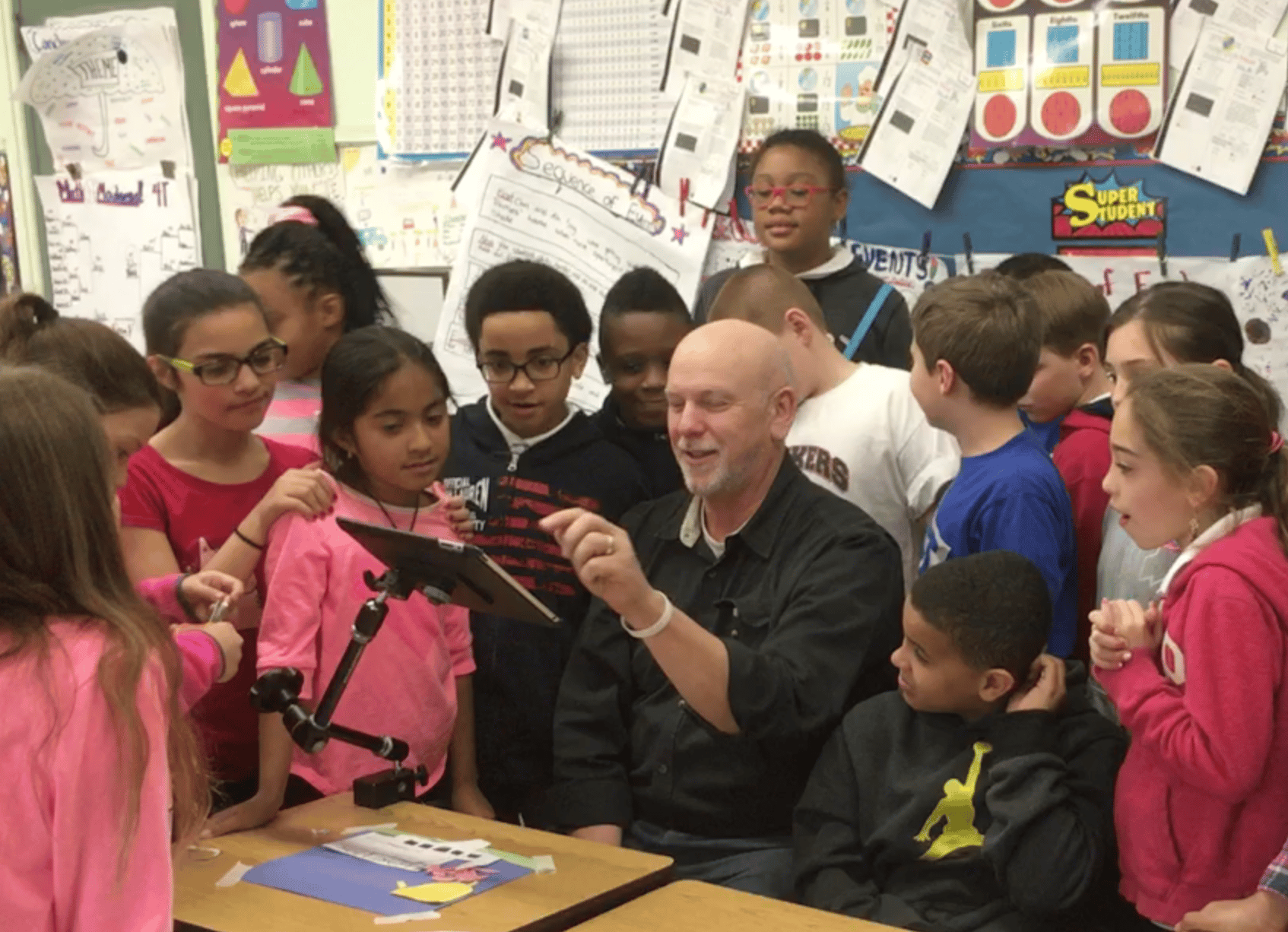
Joe Summerhays is the creative force behind Animating Kids and Animation Chefs, the globally adopted anti-slop media literacy platforms that turn learning spaces into movie studios and students into visual storytellers.
AI can generate infinite content. Joe teaches kids to generate meaning. They learn how sound and motion persuade, shape emotion, and steer perception, then use those tools to author stories on purpose.
Over the past two decades, Joe has trained 25,000+ kids and educators across 20+ countries, giving schools a practical, repeatable system for real media agency.
An award-winning creative executive across software, TV, publishing, and advertising, Joe brings industry-grade persuasion into primary education and flips it into kid defense. His Animation Chefs Colored Hat Levels, inspired by karate belts, guides media coaches from storytelling basics to full film production.
Using handmade cut-paper stop motion, Animating Kids keeps it human. It slows media down frame by frame so students can see how it works, then rebuild it into stories they own. The result: kids who spot manipulation, resist AI slop, and communicate with clarity.
More Testimonials:
"I am impressed by...these programs, providing young people with the skills to become creative and critical thinkers...this shares my dedication to nurturing the next generation of filmmakers and visual storytellers."— Steven Spielberg - Referencing the work of Joe Summerhays“
"Joe (Animating Kids Founder) has turned the art of movie making for kids into a science.” — Jonathan Demme - Academy Award-Winning Director
“I absolutely love Animating Kids...you have no idea how amazing it is for a span of K-9. I’ve got the whole building covered and my planning was done for me. The kids LOVE the Animation Chefs. Win, win!!”— J. Tuttle - Media Specialist
"When I found Animating Kids it changed everything. Small and not so small humans became masters of sound and motion on any subject via small group PBL dynamics."— Rachel - Tech Coach - Quebec
“Animating Kids has changed everything! Fun, relevant media-making lessons for kids, and total P.D. for my non-film making teachers. A complete solution!!” — Principal - Bronx NY
"Animating Kids really helps focus our students during remote sessions…it keeps them so engaged. Your secret recipes are a life saver." — Marisol - Sacramento Ca
"The kids love the demonstrations and it is P.D. for me as I tee it all up. Animating Kids makes me the coolest educator in their lives!" — Charlotte - London UK
"This is the most important skills-based content for today’s kids. I don't think primary educators get how impactful this approach can be. It respects media content creation as the basic literacy it is for today’s kids. — Monique - White Plains NY
“We went through the entire process (PD workshop) of learning animated filmmaking with our tablets and smartphones. We could barely keep up. In the end we came away exhilarated rather than exhausted.” — Cathy S. - Librarian“
"My head was spinning. It involved: math, writing, science, team building, art, language arts, engineering, improvisation, innovation, acting, etc. Along with another dozen areas I can’t recall. Sneaky comprehensive. Mind blown. Can’t wait to use it in class.” — Marcia - 4th Grade Teacher
“Animation Chefs have created a really inspired program! My test group of (hardened gang members) like to laugh at the videos, and they love the simple clear explanations. They just have a blast...”
— G. Zucker Austin TX
"Thank you SO much for sharing your wealth of information and opening this world to every kid! I first learned about you when my husband introduced our daughter to you. Now I am bringing it into my after school program. I’m so psyched!" — Joy H. Retail After School Specialist
"Kids sign-up for robotics, coding, and stop motion sessions. After taking all three, they rate stop motion as their favorite track BY FAR. Animating Kids is key to our success." — Shane V. After School District Lead